Overview
The brief: a new Railroad mini-game where players steal territory from each other. I designed the full player journey, from trigger to resolution, plus lightweight guidance for the art team, around one hypothesis: a social game mode will increase session time after it’s played, because players have more fun.Concept project, not affiliated with or endorsed by Scopely.
Role
Solo concept: research, UX and art direction
Deliverables
Player journey, system blueprint, wireframe flows, art guide
Success metrics
Session length after playing, actions after playing, churn vs. other mini-games
Platform
Mobile (iOS / Android)
In depth
The methods and tools I chose for this project. They change with every project, depending on what the problem needs.
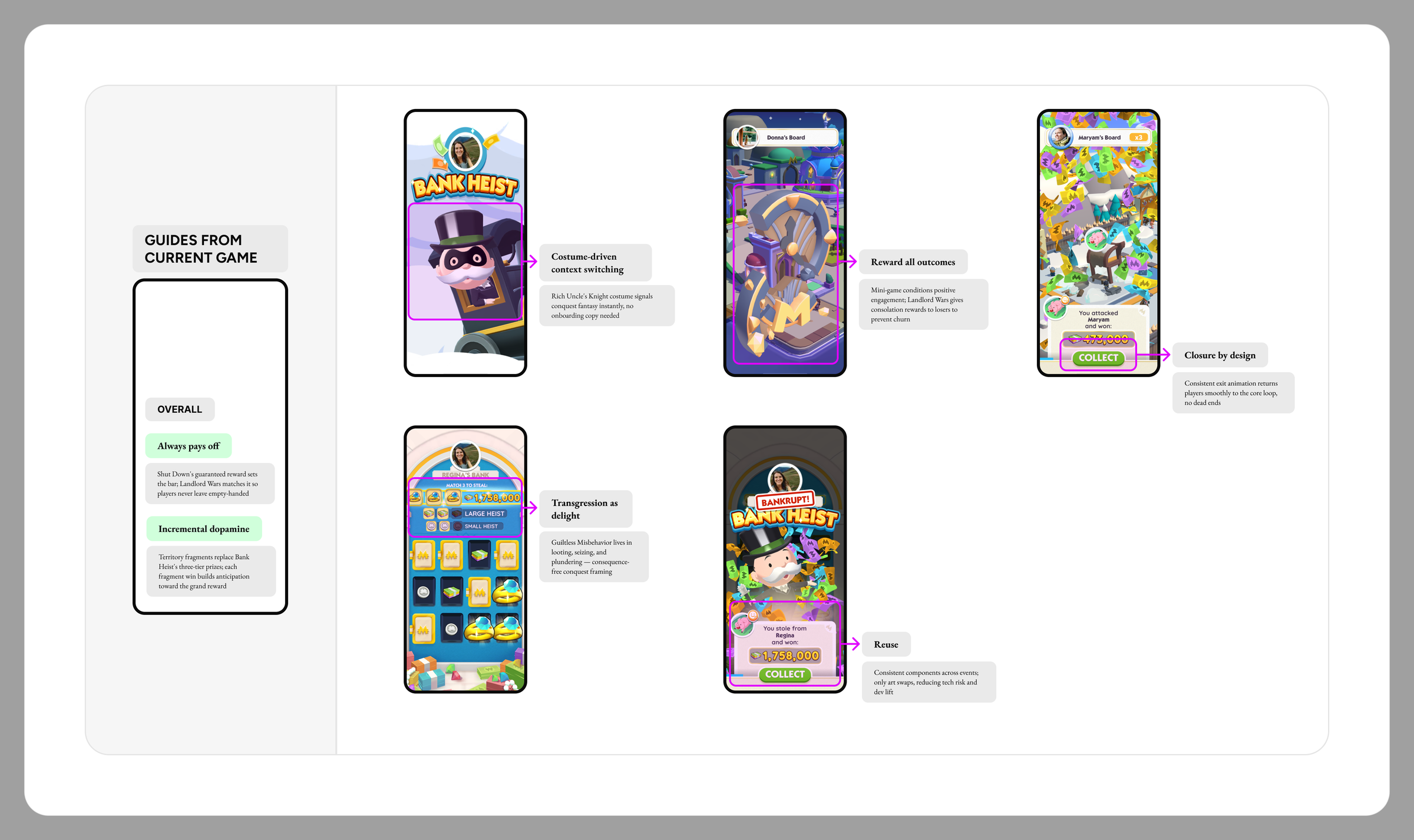
In-game analysis
I broke down the existing mini-games (Shut Down, Bank Heist) to find the patterns players already know. Three stood out:
- Every outcome is rewarded.
- Costumes set context (the Rich Uncle as a Knight) without onboarding copy.
- The same components are reused across events, with only the art changing.
Landlord Wars matches those expectations: guaranteed rewards and incremental fragment wins in place of tiered prizes.
Ideation
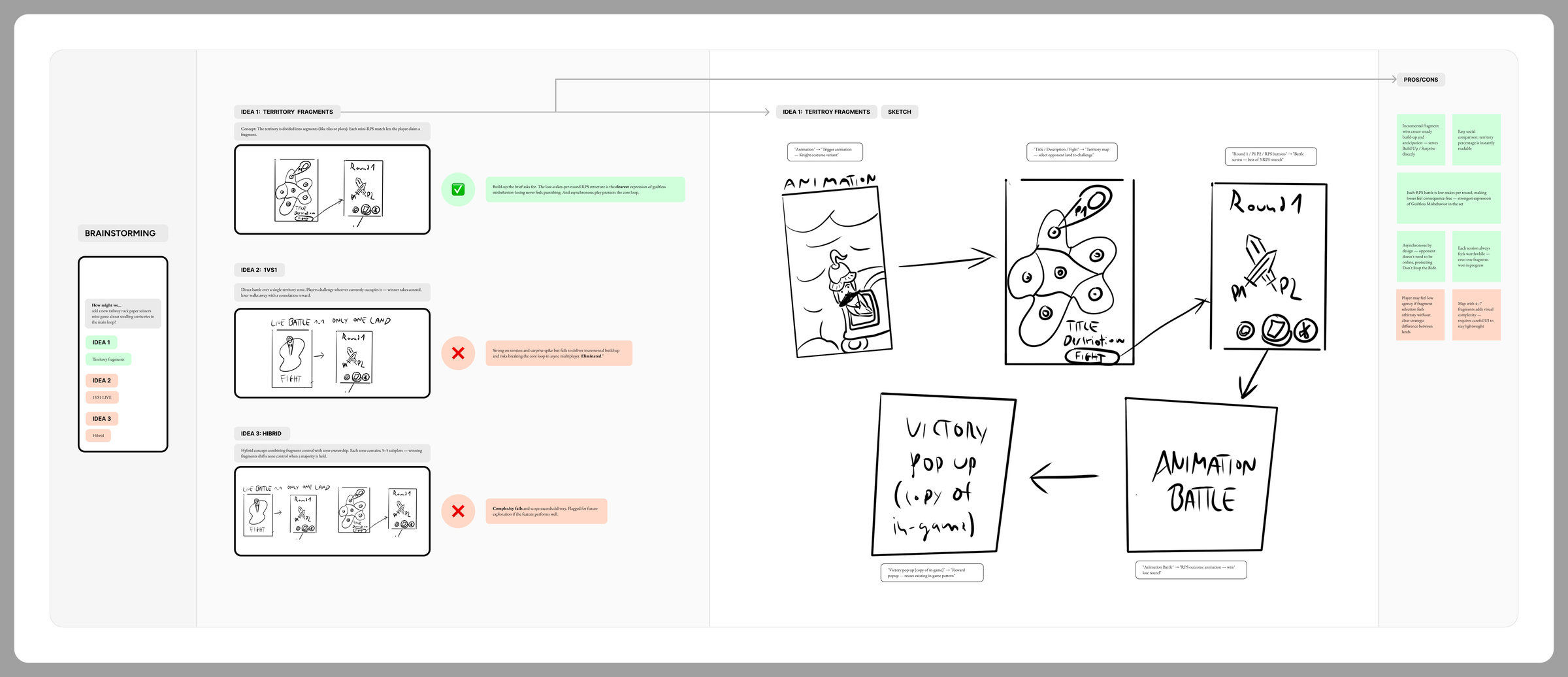
I explored three concepts against the brief's pillars: Don't Stop the Ride, Build Up / Surprise, and Guiltless Misbehavior.
- Chosen · Territory FragmentsIncremental wins build anticipation, low-stakes rounds make losses feel consequence-free, and async play protects the dice loop.
- Dropped · 1v1 LiveStrong tension but no build-up, and risky in async multiplayer.
- Parked · Hybrid zonesToo complex for the scope, so I parked them for later.
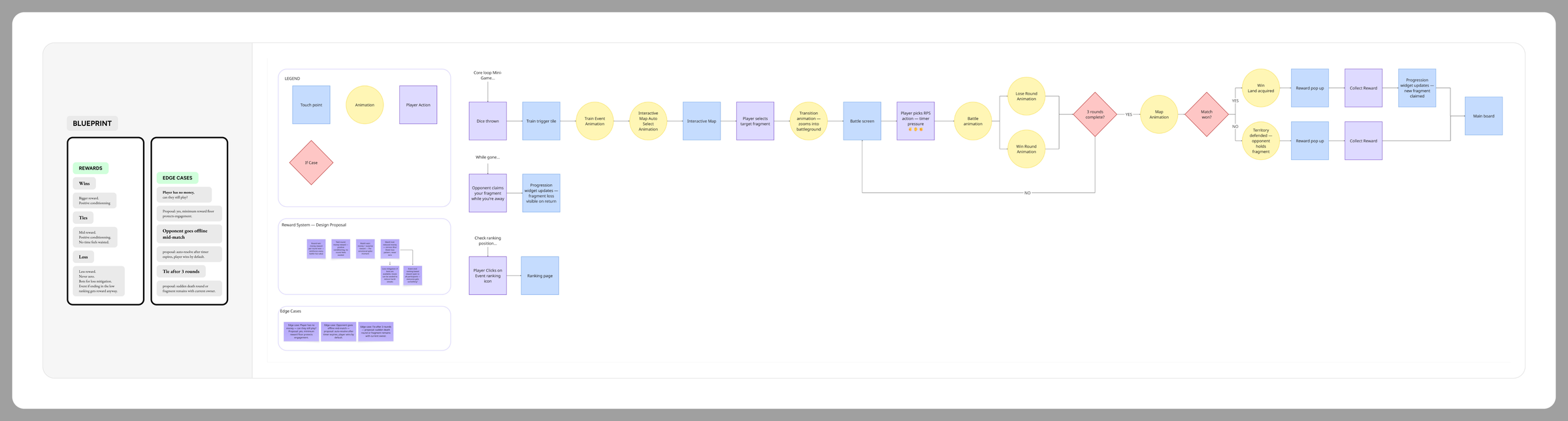
System blueprint and edge cases
I mapped the full system, including the reward logic: wins pay most, ties pay a mid reward, and losses pay less but never zero.
I also defined proposals for the edge cases:
- No money
- Still plays: minimum reward floor
- Opponent goes offline
- Auto-resolves when the timer ends
- Tie after three rounds
- Sudden death
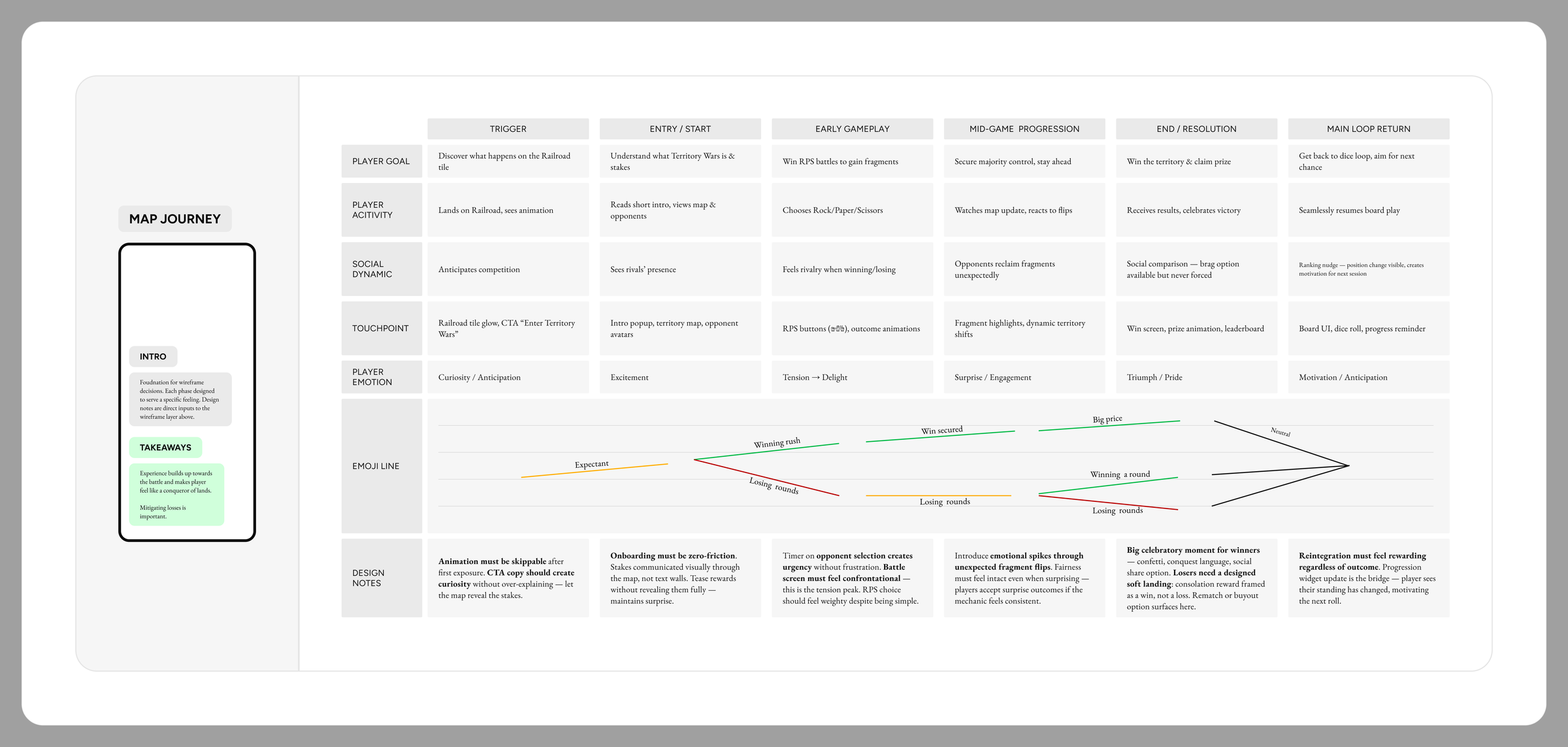
Emotional journey map
I charted player emotion and social dynamics across six phases, from anticipation to the rush of winning and the dip of losing a round. Each phase serves a specific feeling, and the notes fed directly into the wireframes.
- TriggerCuriosity, anticipation
- EntryExcitement
- Early gameTension → delight
- Mid-gameSurprise, engagement
- ResolutionTriumph, pride
- Back to the boardMotivation
The experience should build toward feeling like a conqueror, while losses are actively softened.
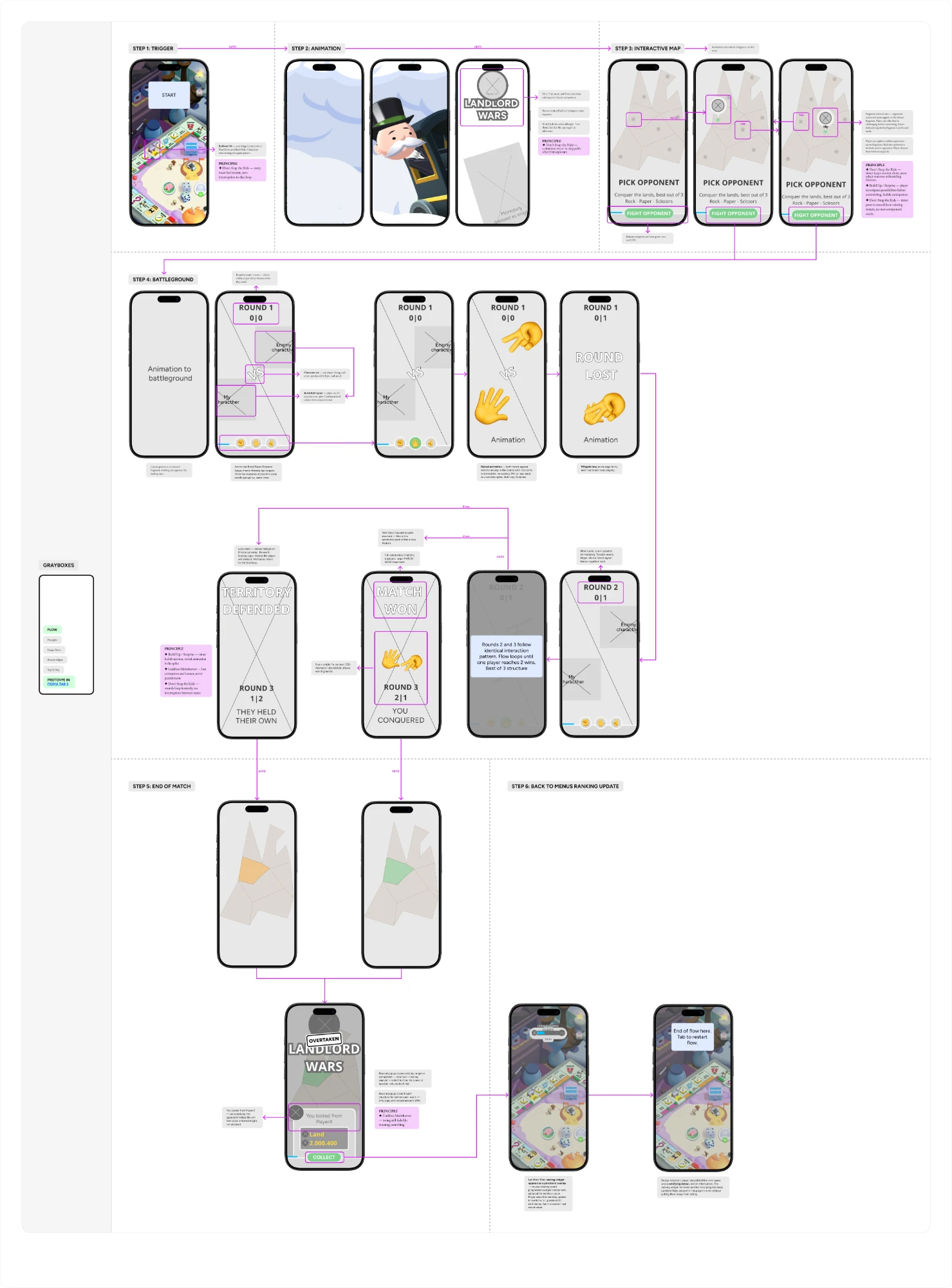
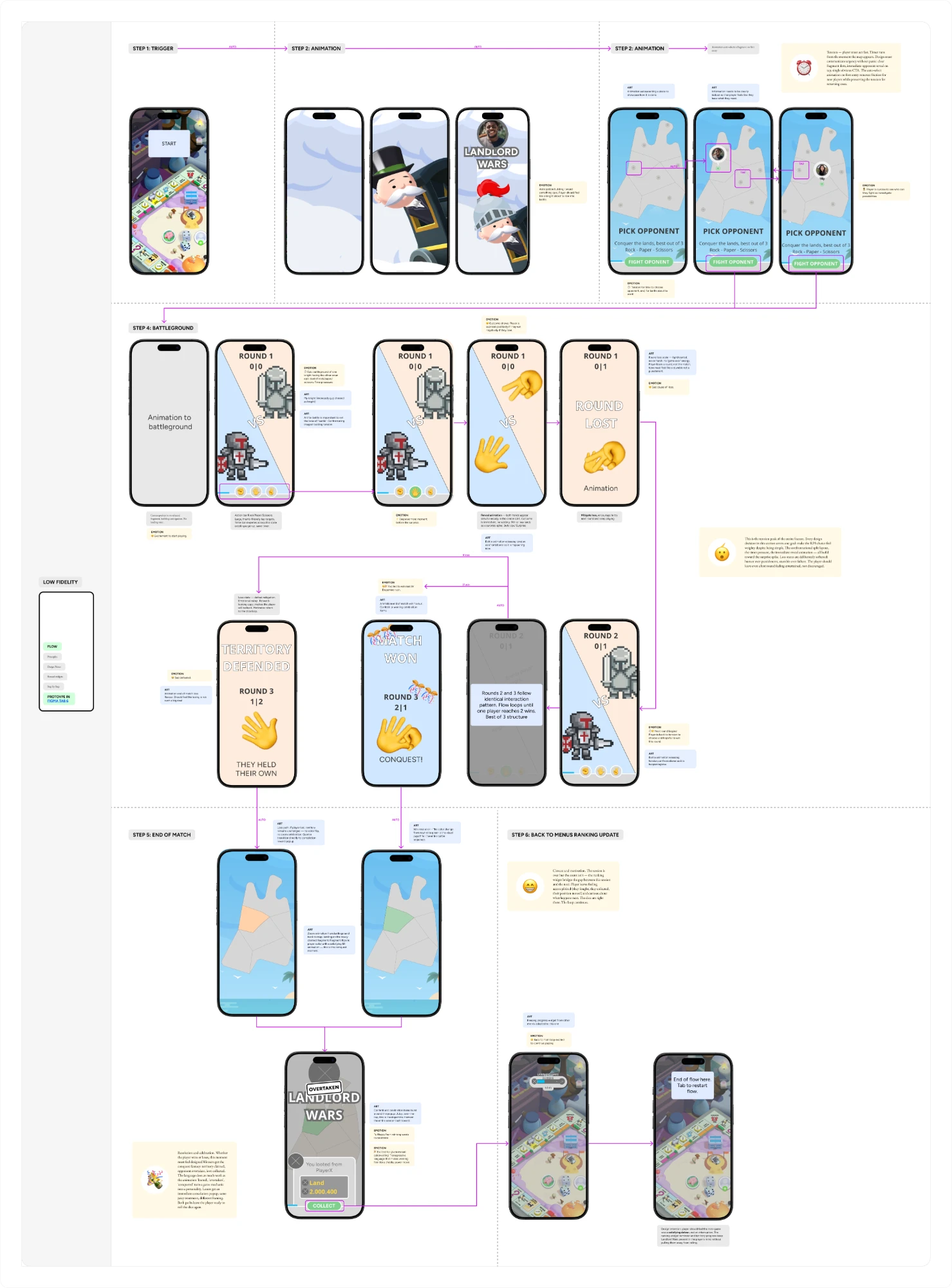
Wireframe flow
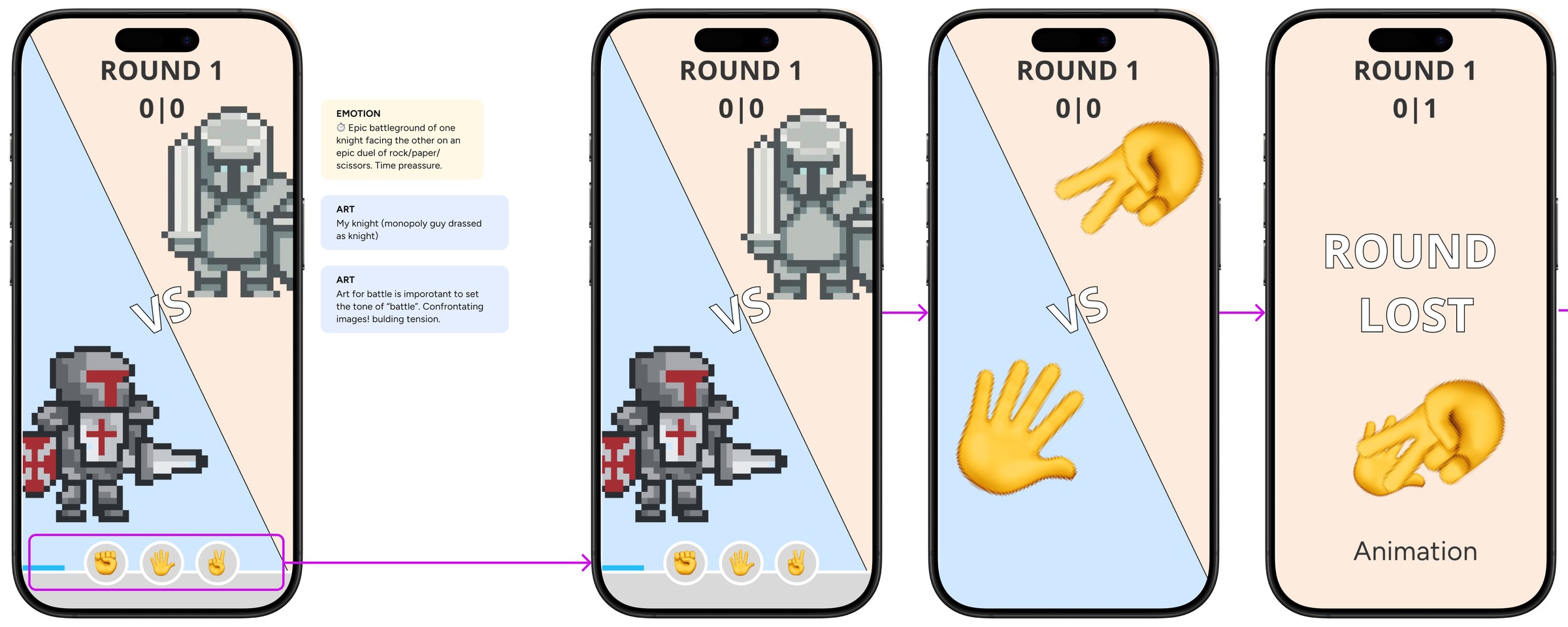
I built a six-step flow, first in graybox and then low-fi. Every screen is annotated with the principle it serves, its emotion and its art notes.
- Trigger
- Animation
- Interactive map
- Battleground
- End of match
- Back to the board, with a ranking update
Most UI reuses existing components, keeping tech risk low:
- Timer bar
- Reward popup
- Event progress widget
Open the flow in Figma (opens in a new tab)
Art guide
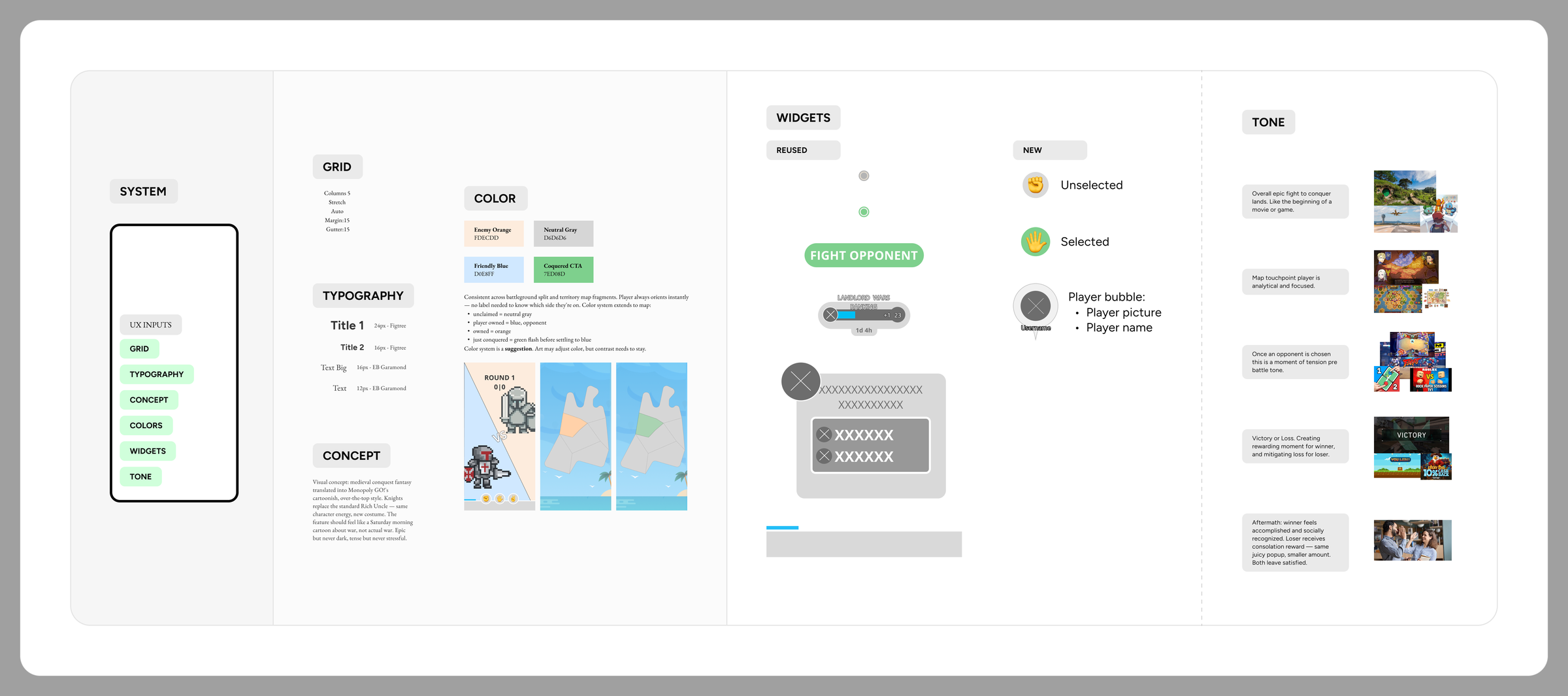
I gave the art team a lightweight system: grid, typography, a color language so players always know which side they are on, a widget inventory split into reused vs. new, and tone references for each moment.
- Friendly blue#D0E8FF · player-owned
- Enemy orange#FDECDD · opponent-owned
- Conquered green#7ED08D · just conquered
- Neutral gray#D6D6D6 · unclaimed
The concept was a “Saturday morning cartoon about war”: epic but never dark.
Insights
Key takeaways from the project.
- Loss mitigation is the real design problem. The win path designs itself; the work was making a lost round feel like a stumble, not a punishment.
- Reuse is a design decision. Building on existing components kept the feature familiar to players and cheap for engineering.
- Emotion first, screens second. The journey map made every wireframe decision traceable to a feeling.
- If I took it further: A/B test whether the mode lengthens sessions without pulling players away from rolling, and explore “Last-Chance Comeback”, a cheeky fragment steal that adds surprise to losing.